
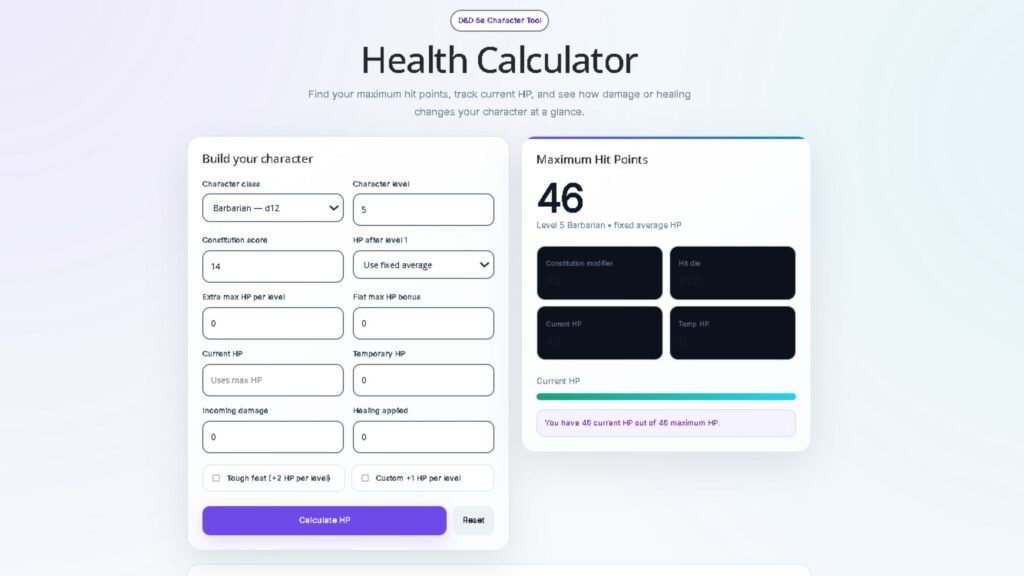
D&D 5e HP Calculator – Calculate Your Hit Points
A D&D health calculator makes tracking your character’s health simple, whether you’re starting a new adventure or preparing for your next battle. Instead of working through the math yourself, use this D&D 5e HP Calculator to estimate your character’s hit points based on class, level, and Constitution.
It helps you check your maximum hit points, understand how Hit Dice affect your total, and keep track of your current health. You can also account for bonuses that change your character’s HP. Whether you’re a beginner or an experienced player, this tool saves time and helps you focus on the fun: playing Dungeons & Dragons.
D&D 5e HP Calculator
The D&D 5e HP Calculator helps you work out D&D hit points from your class, level, and Constitution. It can also help track current hit points, temporary hit points, and other changes during play.
Instead of reaching for dice and a calculator, you can enter your character details once. The result gives you a clearer picture of your D&D character health before the next encounter begins.
Class, Level, and Constitution
Three details drive most HP calculations: your character class, character level, and Constitution score. Your class determines the Hit Die you use, while your level determines how many Hit Dice you have.
Your Constitution modifier then adds to your HP. For example, a first-level Fighter uses a d10 and adds the Constitution modifier to that starting amount.
| Character detail | What it affects |
| Character class | Your Hit Die size |
| Character level | Number of Hit Dice |
| Constitution score | Constitution modifier |
| Constitution modifier | HP gained from each level |
Maximum Hit Points in D&D 5e
Your maximum hit points represent the most normal HP your character can have. At first level, the 2014 rules give you the highest result of your class Hit Die plus your Constitution modifier.
When leveling up, you gain another Hit Die. You can roll it and add your Constitution modifier, or use your class’s fixed value. The result increases your maximum HP by at least one.
A Constitution modifier increase can also raise your existing maximum. Under the 2014 rules, a +1 modifier increase adds one HP for every level you have attained.
Hit Dice and Your Hit Dice Pool
Your hit dice represent the dice connected to your class and level. A Barbarian uses a d12, while a Wizard uses a d6. Your hit dice pool grows as you gain levels because you gain one additional Hit Die with each level.
Hit Dice have another purpose beyond maximum HP. During a short rest, you can spend available Hit Dice to regain HP. You roll the die and add your Constitution modifier to the result.
| Class | Hit Die | Fixed HP after level 1 |
| Barbarian | d12 | 7 + CON |
| Fighter | d10 | 6 + CON |
| Paladin | d10 | 6 + CON |
| Ranger | d10 | 6 + CON |
| Bard | d8 | 5 + CON |
| Cleric | d8 | 5 + CON |
| Druid | d8 | 5 + CON |
| Monk | d8 | 5 + CON |
| Rogue | d8 | 5 + CON |
| Warlock | d8 | 5 + CON |
| Sorcerer | d6 | 4 + CON |
| Wizard | d6 | 4 + CON |
These fixed values come from the 2014 class rules.
How to Use the D&D 5e HP Calculator
Using a D&D 5e HP Calculator is straightforward. Start by selecting your class and entering your character level. Then enter your Constitution score so the tool can determine the correct modifier.
Next, choose whether you want fixed HP or rolled HP when appropriate. You can then account for bonuses, current health, and temporary health to keep your character sheet accurate.
For example, a level 5 Fighter with a +3 Constitution modifier can use the fixed value of 6 HP for each level after first level. The calculation becomes 10 + 3 at level one, followed by four increases of 9 HP.
What Are Hit Points in D&D 5e?
D&D health points show how much physical punishment your character can withstand. They don’t simply measure wounds. Instead, the rules treat HP as a broader measure of endurance, luck, stamina, and the ability to avoid serious harm.
Your current hit points can fall when you take damage. Healing can restore them up to your maximum, while temporary hit points work as a separate buffer against incoming damage.
When taking damage, temporary HP disappears first. Any remaining damage reduces normal HP. If healing restores more HP than you lost, the excess doesn’t push you above your maximum.
What Is a Hit Die in D&D 5e?
A hit die is the die assigned to your class for determining HP. Its hit die size depends on the class you chose. Bigger dice generally provide more HP when you roll them during character advancement.
Your character also gains one Hit Die whenever they gain a level. Therefore, your number of hit dice per level normally matches your character level.
The difference becomes clear when comparing classes. A Barbarian uses a d12, a Fighter uses a d10, several classes use a d8, while Sorcerers and Wizards use a d6.
How Do You Calculate HP in D&D 5e?
To calculate maximum HP, begin with your first-level Hit Die. Use its highest possible result and add your Constitution modifier. A Fighter therefore starts with 10 plus their Constitution modifier under the 2014 rules.
After first level, you can roll your class hit die and add your Constitution modifier. Alternatively, use the fixed value listed for your class. The final increase has a minimum of one HP.
| Example | Calculation | Result |
| Level 1 Fighter | 10 + CON +3 | 13 HP |
| Level 2 Fighter | 13 + 6 + 3 | 22 HP |
| Level 3 Fighter | 22 + 6 + 3 | 31 HP |
| Level 4 Fighter | 31 + 6 + 3 | 40 HP |
This example uses fixed HP after first level. If you choose rolled HP, the increase depends on the actual die result. The official rules allow either approach.
Example: Constitution and Leveling Up
Imagine a seventh-level Fighter with a +3 Constitution modifier. If the character reaches 18 Constitution and the modifier becomes +4, their maximum HP increases by eight because they now have eight attained levels.
This shows why Constitution affects HP beyond simple character creation. A modifier increase can reach backward across your existing levels, making Constitution particularly important for characters who expect frequent combat.
D&D 5e HP by Class
Your HP by class starts with the Hit Die assigned to that class. A larger die doesn’t automatically decide how effective a character will be. It simply changes the mathematical foundation used for their HP.
The table below provides a quick HP by class reference for the 2014 rules. Your Constitution modifier still matters at every level because it contributes to each HP increase.
| Character class | Hit Die | Level 1 HP | Fixed HP after level 1 |
| Barbarian | d12 | 12 + CON | 7 + CON |
| Fighter | d10 | 10 + CON | 6 + CON |
| Paladin | d10 | 10 + CON | 6 + CON |
| Ranger | d10 | 10 + CON | 6 + CON |
| Bard | d8 | 8 + CON | 5 + CON |
| Cleric | d8 | 8 + CON | 5 + CON |
| Druid | d8 | 8 + CON | 5 + CON |
| Monk | d8 | 8 + CON | 5 + CON |
| Rogue | d8 | 8 + CON | 5 + CON |
| Warlock | d8 | 8 + CON | 5 + CON |
| Sorcerer | d6 | 6 + CON | 4 + CON |
| Wizard | d6 | 6 + CON | 4 + CON |
For instance, a Wizard with a +2 Constitution modifier starts with 8 HP. A Fighter with the same modifier starts with 12 HP. That four-point gap comes directly from their different Hit Dice.
D&D 5e HP FAQs
How much HP do you get at level 1 in D&D 5e?
Your hit points at level 1 equal the maximum value of your class Hit Die plus your Constitution modifier. A Wizard starts with 6 plus Constitution, while a Barbarian starts with 12 plus Constitution under the 2014 rules.
What is the highest Hit Die in D&D 5e?
The d12 is the largest standard Hit Die used by the 2014 player classes. Barbarians use it, giving them the highest starting Hit Die value before applying their Constitution modifier.
How does Constitution affect HP?
Your Constitution modifier contributes to your HP when you gain levels. It also affects your starting HP. If your modifier increases, your maximum HP increases by one per attained level for each point of modifier gained.
Can I roll for HP when I level up?
Yes. The 2014 rules let you roll the appropriate Hit Die and add your Constitution modifier. You can instead take the fixed value shown in your class description.
What is the difference between maximum HP and current HP?
Maximum HP is your normal upper limit. Current HP shows how much health you have right now. Damage lowers current HP, while normal healing raises it without exceeding the maximum.
What are temporary hit points?
Temporary hit points act as a protective buffer. Damage removes them before normal HP. They aren’t added to your actual maximum, and healing doesn’t restore them.
Does increasing Constitution increase my HP?
Yes. When your Constitution modifier increases, your maximum HP increases by one for each character level you have attained for every one-point modifier increase.
Is this D&D HP calculator for 5e or 5.5e?
This guide uses the D&D 5e rules from the 2014 ruleset. The 2024 rules changed some fixed HP values, so players should select the correct ruleset when checking character health.
Can I calculate HP manually without a calculator?
Yes. The basic math is simple once you know your class, level, Hit Die, and Constitution modifier. However, a calculator reduces repeated arithmetic and makes it easier to track D&D character HP during character creation or advancement.
Does every D&D class use the same Hit Die?
No. Each class has its own Hit Die. Barbarians use d12, Fighters use d10, many classes use d8, while Sorcerers and Wizards use d6 under the 2014 rules.
Can I use the calculator for an existing character?
Absolutely. Enter your existing class, level, Constitution, and relevant hit point bonus values. You can then compare the calculated maximum with your character sheet and spot arithmetic mistakes.
Final Thoughts on the D&D 5e HP Calculator
Knowing your HP makes character management much easier. Whether you’re creating a new hero or recovering hit points after a difficult encounter, the right calculation keeps your character sheet reliable.
The biggest factors remain your class, Hit Die, level, and Constitution. Once those pieces are clear, you can calculate hit points quickly and spend more time playing instead of checking numbers. The official 2014 rules provide the underlying formulas used throughout this guide.
