
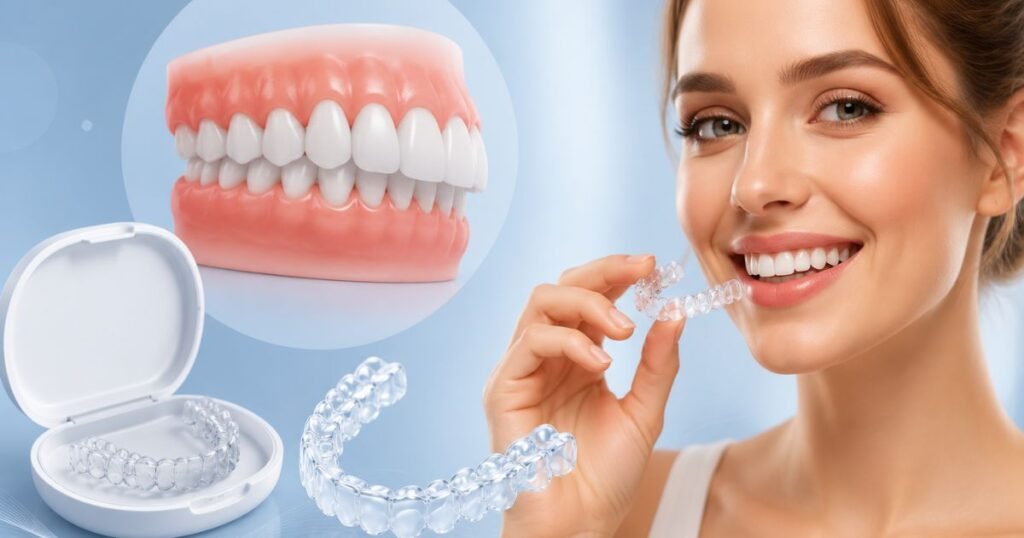
Angel Aligner for Overbite: Effectiveness, Technology, and Clinical Evaluation
An overbite may seem like a simple cosmetic concern, yet it can affect chewing, tooth wear, jaw comfort, and long-term oral health. Angel Aligner for overbite treatment uses custom clear aligners to guide teeth into healthier positions through carefully planned stages. In selected growing patients, advanced features may also support bite correction and lower-jaw guidance.
However, results depend on the cause of the overbite, its severity, your age, and daily wear habits. A qualified orthodontist must assess your teeth, gums, jaw growth, and facial balance before recommending treatment. This guide explains the technology, clinical evidence, benefits, limitations, costs, and how Angel Aligner compares with Invisalign for different overbite cases today.
Table of Contents
Angel Aligner Company and Clear Aligner System Overview
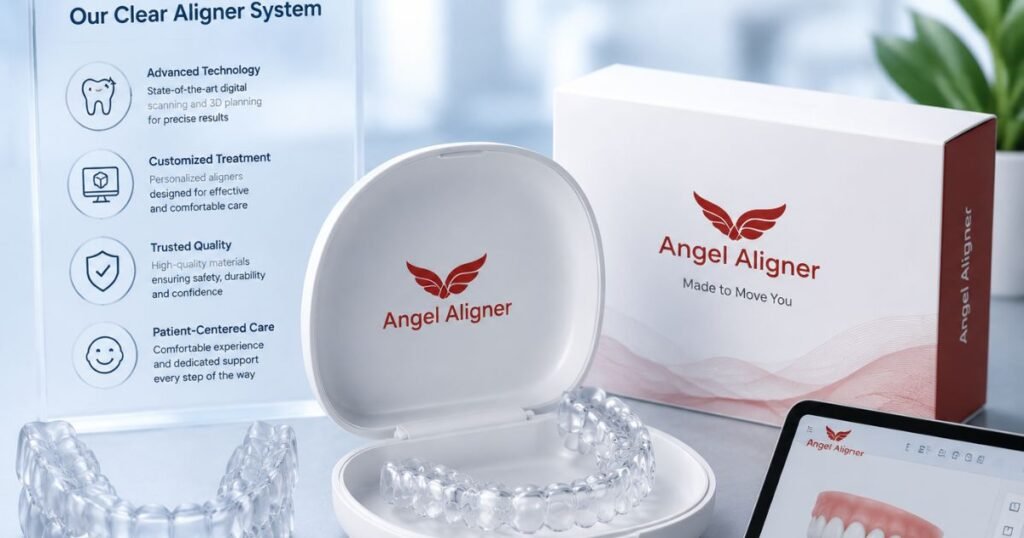
Angel Aligner produces prescription-only removable aligners for permanent and mixed dentition. Its FDA documentation describes patient-specific appliances that align teeth and may reposition the lower jaw. Patients generally remove the trays for eating and cleaning.
The system includes several product lines and clinical features. These include A6 mandibular advancement, Angel Aligner Pro, Select, KiD, angelButton, and digital planning tools. Together, they support teeth straightening, jaw guidance, elastic wear, and selected forms of bite correction.
How Angel Aligner works
Understanding how Angel Aligner works begins with sequential custom aligners. Each tray applies controlled pressure toward planned positions. The orthodontist decides which teeth move, how quickly they move, and whether attachments, elastics, occlusal blocks, or different materials are required.
Digital treatment planning
A digital dental scan creates a detailed record of the teeth. Planning software converts that information into a 3D smile model. The clinician then develops an orthodontic treatment plan that maps alignment, root control, bite opening, and jaw-position changes before manufacturing begins.
FDA clearance in the United States
The FDA found the reviewed Angel Aligner device substantially equivalent to predicate devices for treating malocclusion. Its documented indications include tooth alignment and optional mandibular repositioning. Clearance supports legal marketing for intended use, but it doesn’t prove superiority over competing systems.
What an Overbite Is and Why Correct Diagnosis Matters
An overbite measures how far the upper front teeth vertically cover the lower front teeth. Some overlap is normal. A deep bite occurs when the overlap becomes excessive. Overjet differs because it measures horizontal projection rather than vertical coverage.
Correct diagnosis matters because similar smiles may need different treatments. A dental deep bite may respond to tooth movement. A skeletal Class II pattern may involve a retrusive lower jaw. Severe adult skeletal problems sometimes require surgery rather than aligners alone.
Dental overbite versus skeletal overbite
A dental overbite mainly reflects tooth position, arch shape, or eruption. A skeletal overbite involves jaw growth or jaw relationships. The orthodontist may use photographs, X-rays, scans, facial assessment, and bite measurements to identify the main cause.
Overbite versus overjet
People often use “overbite” when their upper teeth stick forward. That description may indicate overjet. Deep vertical overlap and excessive horizontal projection can occur together, but they require different movement strategies and different expectations for smile correction.
Why a smile assessment matters
A professional smile assessment evaluates the bite, gums, enamel, roots, jaw joints, facial proportions, and growth status. Online photographs can’t show every anatomical limit. Safe personalized orthodontic care therefore starts with records rather than a brand comparison.
How Angel Aligner Treats Overbite and Class II Malocclusion
Angel Aligner for overbite can use several biomechanical strategies. These may include front-tooth intrusion, posterior extrusion, torque changes, molar movement, Class II elastics, and mandibular advancement. The chosen method depends on the patient’s age and bite pattern.
For growing patients, A6 uses inclined occlusal blocks that guide the lower jaw forward while the aligners move teeth. Angel Aligner markets this system for retrognathic Class II malocclusions and simultaneous alignment.
How clear aligners move teeth
The phrase how clear aligners move teeth describes controlled force applied through fitted plastic. Teeth respond biologically over time. Accurate movement control requires appropriate staging, tray fit, root planning, and consistent wear. Predicted movement may not express fully in every patient.
Deep-bite correction
Deep-bite treatment may intrude incisors, upright front teeth, or encourage controlled posterior eruption. Some cases need several methods together. The 2025 systematic review on clear-aligner deep-bite treatment found useful correction but also examined differences between planned and achieved movement.
Class II correction and mandibular advancement
A6 combines tooth alignment with forward mandibular positioning. Its blocks aim to support bite opening and Class II correction in growing patients. However, growth response varies. Dental changes may contribute substantially to the final result.
Attachments, buttons, and elastics
Orthodontic attachments create extra contact areas for difficult movements. Aligner buttons support elastic traction. AngelButton is manufactured into the tray, while bonded buttons attach directly to teeth. These features can help guide the bite but don’t remove the need for careful monitoring.
Angel Aligner Products Used for Overbite Treatment
Angel Aligner offers several systems rather than one universal appliance. A6 targets selected Class II growth problems. Pro uses a dual-material approach. Select supports broad treatment planning, while KiD addresses early development during mixed dentition.
The orthodontist chooses among these products after evaluating case complexity, growth, tooth position, and planned force systems. Product names should never replace diagnosis. Two patients with similar-looking overbites may need entirely different mechanics.
Angel Aligner A6
A6 uses built-in occlusal blocks to advance the mandible in growing Class II patients. It can combine alignment and orthopedic guidance within one sequence. This feature distinguishes A6 from ordinary aligner trays designed only for tooth movement.
Angel Aligner Pro
Angel Aligner Pro uses two aligner materials with different mechanical properties. The manufacturer positions masterControl S for general alignment and masterControl for movements needing greater force retention, including torque, bodily movement, and deep-bite correction.
Angel Aligner KiD
Angel Aligner KiD combines alignment, functional correction, space management, and jaw-growth guidance. It is designed for growing children from mixed dentition onward. Early treatment should still address a defined problem rather than begin solely because a child is young.
Angel Aligner built-in buttons
Angel Aligner built-in buttons refer to angelButton features formed within the aligner. They can provide anchorage for elastics without adding a separate tooth-bonded button. However, some cases still need conventional tooth-colored attachments or other auxiliaries.
Clinical Evidence for Angel Aligner Overbite Treatment
The available evidence supports cautious optimism rather than certainty. Angel Aligner has FDA documentation, company case reports, and some published clinical work. Yet its independent product-specific literature remains smaller than the broader evidence base for clear-aligner therapy.
A published case report described successful A6 treatment for a 12-year-old with skeletal Class II deep-bite malocclusion. That result shows feasibility in one carefully managed case. It cannot establish an average success rate or prove superiority over braces or Invisalign.
Angel Aligner case evidence
The A6 case report evaluated three-dimensional dental and skeletal changes. It documented nonsurgical treatment in a growing patient. Still, case reports lack comparison groups and may reflect unusually favorable compliance, growth, diagnosis, or clinician expertise.
Broader clear-aligner evidence
Research suggests clear aligners can correct selected dental deep bites through anterior intrusion and posterior extrusion. A recent Invisalign case series reported mainly dental changes with minimal skeletal alteration in adults. These results shouldn’t automatically be transferred to every product or patient.
Treatment precision and refinements
Digital plans show intended movement rather than guaranteed movement. Real teeth may track differently because of anatomy, force expression, or patient compliance. This explains why treatment refinements are common in complex clear-aligner care.
Reading Angel Aligner reviews carefully
Angel Aligner reviews can reveal comfort, service, and daily-use experiences. However, reviews rarely include diagnostic records or measured outcomes. They shouldn’t replace peer-reviewed research, FDA documents, or evaluation by a qualified orthodontist.
Angel Aligner vs Invisalign for Overbite Correction
The Angel Aligner vs Invisalign question has no universal winner. Both systems offer transparent trays, digital planning, attachments, and mandibular-advancement options. Angel Aligner emphasizes A6, integrated buttons, and dual materials. Invisalign uses SmartTrack, SmartForce attachments, ClinCheck, and mandibular-advancement designs.
The most important what is the difference between Angel Aligner and Invisalign answer concerns product features, research depth, provider availability, and clinical planning. Invisalign has a larger published footprint. Angel Aligner offers distinctive tools that may suit selected treatment mechanics.
| Comparison area | Angel Aligner | Invisalign |
| Core system | Doctor-planned removable trays | Doctor-planned removable trays |
| Deep-bite features | A6, dual materials, attachments, elastics | Bite ramps, SmartForce features, mandibular advancement |
| Material approach | Multiple proprietary material options | Proprietary SmartTrack material |
| Integrated button | AngelButton available | Elastics commonly use bonded or precision-cut features |
| Child treatment | Angel Aligner KiD | Invisalign First |
| Evidence base | Emerging product-specific literature | Larger published research base |
| Daily wear | Generally prescribed 20–22 hours | Provider-directed, commonly near full-time wear |
| Best choice | Depends on diagnosis and provider expertise | Depends on diagnosis and provider expertise |
Which is better Angel Aligner or Invisalign?
For which is better Angel Aligner or Invisalign, choose the system that supports the required movement in experienced hands. Brand familiarity doesn’t guarantee a better result. The orthodontist’s diagnosis, biomechanics, follow-up, and response to tracking problems often matter more.
Angel Aligner compared with Invisalign
Angel Aligner compared with Invisalign offers more than a material comparison. A6 uses occlusal blocks for mandibular advancement, while current Invisalign systems also offer advancement blocks for Class II cases, including deep bites.
Angel Aligner material quality
Questions about Angel Aligner material quality often focus on clarity, force retention, and tear resistance. Angel Aligner reports stain-resistant, dual-material options. Yet independent head-to-head evidence remains insufficient to confirm that one system stays clearer or performs better for everyone.
Invisalign aligner material
Invisalign aligner material uses the proprietary SmartTrack multilayer system. Invisalign states that SmartTrack supports controlled movement and easier insertion. These statements come partly from manufacturer research, so comparisons should consider study design and patient type.
Do Angel Aligners stay clear longer?
For do Angel Aligners stay clear longer, Angel Aligner reports stain resistance and aesthetic stability. However, no strong independent clinical comparison proves that Angel trays remain clearer than Invisalign across normal diets, cleaning routines, and wear patterns.
Difference between aligner buttons and attachments
The difference between aligner buttons and attachments concerns function and location. Attachments usually help trays grip teeth and direct force. Buttons commonly anchor elastics. AngelButton is integrated into the tray, while many conventional buttons are bonded to tooth surfaces.
Who Is a Good Candidate for Angel Aligner Overbite Treatment?
A suitable candidate generally has healthy teeth and gums, realistic expectations, and enough discipline to follow the prescribed aligner wear schedule. The FDA record describes 20–22 hours of daily wear for the reviewed device.
Angel Aligner for overbite may suit selected adults with dental deep bites and growing patients with Class II mandibular retrusion. Severe skeletal discrepancies, poor periodontal health, impacted teeth, or unreliable wear may require another approach.
Who is a good candidate for Angel Aligner?
The answer to who is a good candidate for Angel Aligner depends on diagnosis. Suitable patients may have manageable crowding, spacing, overjet, deep bite, or Class II relationships that can be addressed through planned aligner mechanics.
Angel Aligner vs Invisalign for adults
Angel Aligner vs Invisalign for adults should focus on the required tooth movements. Adult jaw growth has largely finished. Therefore, severe skeletal correction may require camouflage, fixed appliances, or surgery rather than mandibular-growth guidance.
Angel Aligner vs Invisalign for teenagers
Angel Aligner vs Invisalign for teenagers includes growth, tooth eruption, sports, school routines, and compliance. A6 may help selected Class II patients. Invisalign also provides teen and mandibular-advancement options. Provider experience remains crucial.
Who is a good candidate for Invisalign?
For who is a good candidate for Invisalign, similar principles apply. The patient needs appropriate tooth and jaw conditions, healthy tissues, realistic goals, and reliable wear. Some cases remain better suited to braces or combined treatment.
Angel Aligner Overbite Treatment Process
The clear aligner treatment process starts with records rather than tray selection. The clinician examines the bite, facial profile, gum health, root position, and jaw relationship. A scan then supports digital planning and appliance production.
During treatment, the orthodontist checks tray fit and movement. Additional orthodontic attachments, elastics, or refinements may become necessary. Regular monitoring protects treatment efficiency and identifies tracking failures before they become larger problems.
Digital scan for clear aligners
A digital scan for clear aligners captures tooth surfaces without traditional impressions. The scan supports planning and manufacturing. X-rays remain important because surface scans cannot show roots, bone levels, impacted teeth, or skeletal relationships.
3D treatment planning for aligners
3D treatment planning for aligners allows the clinician to stage movements and visualize expected changes. Yet the animation is a plan, not a promise. Biological response and appliance fit can alter the achieved result.
How long should aligners be worn daily?
For how long should aligners be worn daily, Angel Aligner’s FDA documentation describes 20–22 hours per day. Patients usually remove trays for food and cleaning. Lower wear time can reduce tracking and extend treatment duration.
Angel Aligner wear schedule
The Angel Aligner wear schedule depends on the prescribed sequence and material system. Patients shouldn’t change trays early without instructions. Each stage needs sufficient time to express movement and allow tissues to respond safely.
Treatment emergencies
Possible treatment emergencies include damaged trays, severe pain, lost aligners, loose attachments, or broken elastic features. Integrated buttons may reduce some bonded-button repairs. Still, patients should contact their orthodontic office rather than improvise permanent fixes.
Benefits, Limitations, Risks, Cost, and Availability
Common Angel Aligner benefits include removability, discreet appearance, easier cleaning, digital planning, A6 jaw guidance, and specialized material choices. These features can support lifestyle-friendly treatment when patients consistently wear and care for their trays.
Limitations include tracking errors, refinement needs, variable compliance, and reduced control in some difficult movements. Risks of orthodontics may include tenderness, root resorption, gum recession, enamel damage, relapse, and unwanted bite changes. A clinician should explain individual risk.
Patient comfort and daily life
Smooth plastic and smooth aligner edges may improve patient comfort compared with metal hardware. Still, pressure and speech changes are common early experiences. Neither Angel Aligner comfort nor Invisalign comfort can be guaranteed because sensitivity varies.
Oral hygiene with aligners
Oral hygiene with aligners can be simpler because trays are removable. Patients should maintain careful brushing and flossing before replacing them. Wearing trays over food debris increases plaque exposure and can damage enamel or irritate gums.
Are Angel Aligners removable?
The answer to are Angel Aligners removable is yes. They should usually come out for eating and cleaning. Removability supports convenience but creates a compliance challenge because the trays only work while worn.
Are Invisalign aligners removable?
Likewise, are Invisalign aligners removable has a simple answer: yes. Both systems are examples of clear aligners without metal braces. Patients must balance that freedom with consistent daily wear.
Does Angel Aligner require attachments?
For does Angel Aligner require attachments, some simple cases may use few auxiliaries. Complex cases often need attachments, buttons, hooks, or elastics. Angel Aligner attachments depend on planned movement rather than patient preference alone.
Does Invisalign require attachments?
The answer to does Invisalign require attachments also varies. Invisalign attachments are small tooth-colored shapes used to improve force direction. Difficult rotations, extrusion, root movement, and bite changes may need them.
Cost and insurance
Aligner treatment cost depends on complexity, provider fees, location, refinements, retainers, and imaging. Searches such as is Angel Aligner cheaper than Invisalign or Angel Aligner cost vs Invisalign cost cannot receive one national answer.
Insurance questions
For does insurance cover Angel Aligner and does insurance cover Invisalign, coverage depends on the policy. Some plans provide orthodontic insurance with lifetime limits or age conditions. Patients should verify their exact orthodontic benefits before treatment.
Affordable clear aligners
Patients seeking affordable clear aligners may consider Angel Aligner, Invisalign, Clarity Aligners, or other doctor-supervised systems. A lower starting price isn’t automatically better when it excludes records, refinements, retainers, or complex bite correction.
Finding a provider
Searches for Angel Aligner provider near me or Invisalign provider near me should lead to licensed clinicians who treat similar cases. Ask whether the provider is a board-certified orthodontist and request examples involving the same bite problem.
Local phrases such as Angel Aligner orthodontist in Zionsville may surface practices like Godley Family Orthodontics or another Zionsville orthodontist. Local pages can help identify providers, but their promotional comparisons shouldn’t replace independent evidence.
Final Evaluation and Frequently Asked Questions
The best evaluation of Angel Aligner for overbite is balanced. The system offers credible FDA-cleared technology, mandibular advancement, integrated elastic features, and multiple materials. However, product-specific independent studies remain limited compared with the wider Invisalign literature.
Ultimately, the best clear aligner system is the one that fits your diagnosis and receives competent supervision. A board-certified orthodontist for clear aligners can compare brands, braces, surgery, and other options before recommending treatment.
| Common question | Evidence-based answer |
| Is Angel Aligner worth it? | It may be worthwhile when its features match the diagnosis and the provider has relevant experience. |
| Is Invisalign worth it? | It can be effective for suitable cases, although cost, complexity, and provider skill still matter. |
| Angel Aligner for complex cases | Pro, A6, attachments, and elastics may support complexity, but some cases need braces or surgery. |
| Invisalign for complex cases | Invisalign can treat many complex cases, though success depends on planning and biological limits. |
| Angel Aligner treatment time | It varies with bite severity, age, wear, growth, and refinements. |
| Invisalign treatment time | It also depends on complexity, compliance, and treatment design. |
| Are refinements included with clear aligners? | Inclusion depends on the provider’s contract and treatment package. |
| Affordable alternative to Invisalign | Angel Aligner may cost less in some offices, but national pricing comparisons are unreliable. |
| Clear aligners for bite correction | They may correct selected deep bites and Class II problems under professional supervision. |
| Clear aligners for teeth straightening | Both systems can align suitable teeth through staged movements. |
| Personalized clear aligner treatment | Planning should reflect your teeth, roots, jaws, health, and goals. |
| Orthodontist-designed aligner treatment | Doctor-led planning and monitoring improve safety and clinical control. |
Angel Aligner pros and cons
The main Angel Aligner pros and cons include specialized A6 technology, integrated buttons, multiple materials, emerging U.S. availability, and limited independent comparative research. Its value depends on whether these features solve your exact clinical problem.
Invisalign pros and cons
The main Invisalign pros and cons include broad provider availability, extensive research, established digital tools, brand familiarity, possible higher fees, attachments, and treatment limitations in selected skeletal or difficult cases.
Invisalign benefits
Recognized Invisalign benefits include SmartTrack material, ClinCheck planning, a large provider network, and a mature treatment ecosystem. However, Invisalign marketing claims should still be interpreted in the context of study populations and clinician experience.
Clear aligner consultation
A proper clear aligner consultation should answer the exact diagnosis, skeletal involvement, planned movements, expected auxiliaries, alternatives, total price, refinement policy, retention, and risks. Don’t accept a brand recommendation without a clear clinical explanation.
Final answer
Angel Aligner for overbite can be effective for selected dental deep bites and growing Class II patients. A6, Pro, KiD, attachments, elastics, and dual materials expand its treatment options. Still, diagnosis, growth, compliance, and clinician skill determine whether it is appropriate.
