
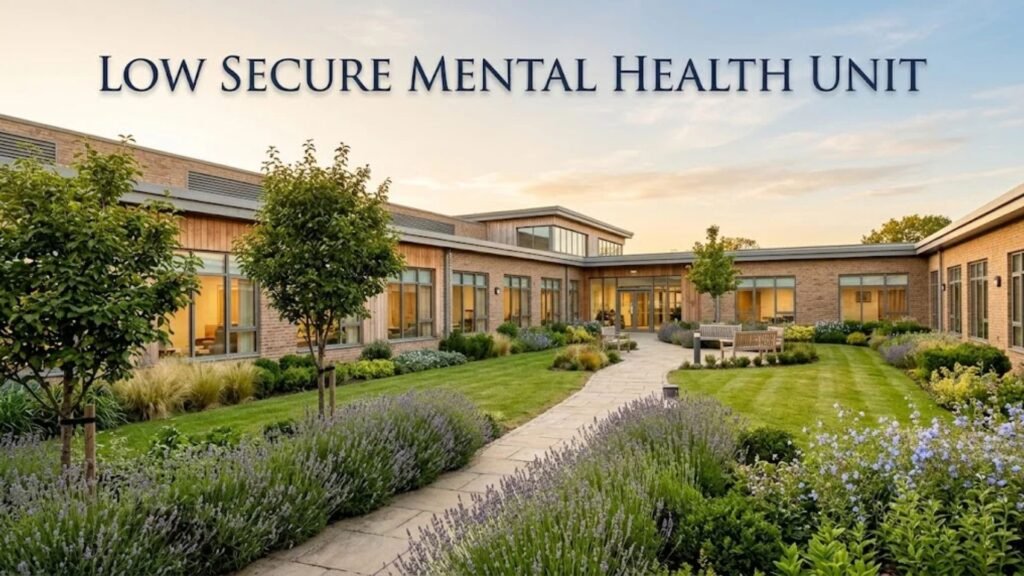
Low Secure Mental Health Unit: What It Is, Who It Serves, and What to Expect
Hearing the words “secure unit” for the first time can feel scary. Maybe a loved one needs help. Maybe you just want answers. Either way, you’re in the right place. A low secure mental health unit is a locked hospital setting. Staff there focus on treatment, safety, and a steady path back to everyday life.
Most people meet this term in the UK. Americans often use other names, such as forensic psychiatric hospital or locked psychiatric unit. This guide explains both. You’ll learn who goes there, how admission works, and what daily life looks like. You’ll also see how families can help. Take it step by step.
Need help right now? If you or someone you know is in crisis in the US, call or text 988 to reach the Suicide and Crisis Lifeline. This article gives general information. It isn’t medical or legal advice.
What Is a Low Secure Mental Health Unit?
A low secure unit is a locked ward inside a hospital. It gives inpatient mental health care to adults with mental illness who need more safety than an open ward can offer. Staff control who enters and leaves. They also watch for risk day and night. Still, the main goal is care. A good unit feels more like a hospital than a jail. It is one of the key secure mental health services in a country’s health system.
Not everyone agrees on one exact definition. A 2011 report from the Centre for Mental Health described low security as more of a concept than one fixed type of service (see the discussion here). In England, NHS England pays for adult secure care through specialist commissioners. Many units sit inside NHS trusts while others belong to independent hospitals. The Care Quality Commission (CQC) inspects them. For example, it rated one 13-bed unit for men in Derbyshire as Good (CQC report).
What Is the US Equivalent of a Low Secure Unit?
The US has no official “low secure” label. Instead, states run forensic mental health services through state hospitals, locked units, and step-down units. For example, Alabama runs a 140-bed forensic hospital with a published patient and family handbook (Alabama Department of Mental Health). That one is a maximum security site, so it sits higher on the scale. Other states keep less restrictive units for patients who are getting better. When you search in the US, try the words “forensic psychiatric unit” or “state psychiatric hospital.”
Low Secure vs. Medium Secure vs. High Secure Units
Secure care has three main levels. A high secure hospital has the strongest security. England has only a few of these, such as Broadmoor and Rampton. A medium secure unit comes next. Most patients from prisons, courts, and high secure sites first go to medium secure. A low secure unit sits at the lowest level of the three. It still has locked doors and tight control, yet it allows more freedom and more leave as patients improve.
The three levels form a ladder. A patient can move down as risk management goes well. That move is called step-down care. It’s also possible to move up if risks grow. Security isn’t a punishment. It is a tool that matches support to need. The table below shows the main difference between low and medium secure and how the levels compare.
Security Levels Compared
Think of the levels like gears on a bike. You shift down when the road gets easier. This table gives a quick view. Keep in mind that exact rules change from one hospital to another.
| Level | Typical Security | Who Is Usually Placed There | US Term (Closest) |
| High secure hospital | Very strong perimeter and tight control | People with the highest risk to others | Maximum security forensic hospital |
| Medium secure unit | Strong security with controlled movement | Many people from courts, prisons, or high secure care | Secure forensic unit |
| Low secure inpatient unit | Locked ward with controlled entry | People who need a safe setting but pose lower risk | State forensic or locked step-down unit |
| Open ward | Little or no locked security | People who can stay safe with light support | General inpatient psychiatric unit |
Who Is Admitted to a Low Secure Mental Health Unit?
People with serious mental illness go to these units. Many live with schizophrenia or other severe conditions. They often have complex mental health needs. Some show challenging behavior or high-risk behavior that open wards can’t manage safely. Others are in acute distress and need close care for longer than a short stay. So who goes to a low secure unit? Mostly adults. Both men and women are admitted, though many wards are single-gender.
Patients come from a few main routes. Some step down from a medium secure unit. Others come from general adult wards or a psychiatric intensive care unit (PICU). A third group arrives from the criminal justice system through a court referral or prison transfer. The NHS England service specification names three main groups: patients needing forensic low secure rehabilitation, patients needing forensic low secure admission, and patients needing extended PICU care (NHS England specification).
Common Patient Groups
A few units serve young people. For example, one specialist low secure unit in Middlesbrough cares for teens aged 12 to 18. Admission there also happens under the Mental Health Act. Unit sizes vary a lot. One men’s ward in London holds 16 beds (South West London and St George’s). Another unit holds 21 men while a nearby unit holds 26 women (Oxford Health). Small numbers allow closer care.
How Admission Works: Referral and the Mental Health Act
In England, admission starts with a referral from a professional. You can’t self-refer. People often ask, “can you self-refer to a low secure unit?” The answer is no. A multidisciplinary team first completes an assessment. They carry out a risk assessment to decide if the person needs secure care. Then specialist commissioners at NHS England give the final approval (Mersey Care).
Nearly every patient is detained under the Mental Health Act. People often say they were sectioned. A section is a legal order for detention and treatment. Staff must explain a patient’s rights on arrival. One NHS trust repeats that explanation every month and whenever the treatment or section changes (Lincolnshire Partnership NHS Trust). The law also covers consent and capacity, which means a person’s ability to make choices about care.
How Involuntary Commitment Works in the US
The US doesn’t use the Mental Health Act. Each state sets its own commitment laws. A short emergency hold often comes first, and many states cap it at about 72 hours. After that, a court hearing decides if longer care is needed. Courts also order treatment for defendants found not competent to stand trial. Because rules differ by state, always check your own state’s law or ask a local legal aid group.
What Daily Life Looks Like Inside a Low Secure Unit

So what happens in a low secure unit each day? The routine feels steady and calm. Patients wake up and take their medication. They eat meals together. They join groups and therapeutic activities such as art or cooking. They also get quiet time and fresh air when it’s safe. Staff keep notes and talk often with each person. Every ward has rules. Those rules protect patients and staff.
Patients usually have their own bedroom. They share a lounge and dining space. Many can use a phone at set times. Staff may check belongings for safety. Personal items still matter, so most units let patients keep photos and clothes. Patient-centered care means the routine should fit the person as far as safety allows. A low secure mental health unit can feel strict at first. Over time, many patients say the structure helps.
A Sample Day Table
Every hospital runs its own schedule. This table shows a typical pattern. Times are examples only.
| Time | Activity |
| 7:30 AM | Wake up, wash, and take morning medication |
| 8:30 AM | Breakfast and morning check-in with a mental health nurse |
| 10:00 AM | Skills groups or talking therapy |
| 12:30 PM | Lunch |
| 2:00 PM | Therapeutic activities, such as gardening, art, or sport |
| 5:30 PM | Dinner |
| 7:00 PM | Phone calls, TV, or visits |
| 10:00 PM | Evening medication and lights out |
Treatment and Therapies Offered
A multidisciplinary team runs the care. It includes psychiatrists, mental health nurses, psychologists, occupational therapists, and social workers. Each expert adds a piece. The psychiatrist reviews medication. The psychologist offers psychological therapy. The occupational therapist builds daily skills. Together they write a care plan. That plan sets clear goals from the start. It also changes as the patient improves.
Treatment mixes several tools. Medication helps control symptoms. Talking therapy helps patients understand thoughts and feelings. Skills groups teach things like managing anger and handling stress. Staff also focus on recovery and rehabilitation. That means rebuilding confidence and routine. Good recovery planning looks ahead, not back. The aim isn’t just safety. It’s a better life after discharge.
Building Skills for Life Outside
Daily living skills matter as much as therapy. Patients often practice cooking, budgeting, and travel. They learn to spot early warning signs of illness. They also plan how to ask for help. Some units offer work training or education. These steps build hope. They also give the team proof that a patient can manage risk in the wider world.
Patient Rights, Advocacy, and Tribunals
Patients keep important rights inside a secure unit. They can ask for independent advocacy. An advocate isn’t a hospital employee. This person helps patients speak up and understand their options. In England, a patient can also ask a mental health tribunal to review a section. A tribunal is an independent panel. It can end a detention if the legal tests aren’t met. Patients can appeal, and staff must help them reach the right support.
The US has a similar idea with different names. Patients can ask a court to review their commitment. Many states also have a patients’ bill of rights. Connecticut, for example, has one that guarantees humane and dignified treatment (court discussion). In the US, each state has a protection and advocacy agency for people with disabilities. You can find yours through the National Disability Rights Network.
Where to Get Help and Advocacy
Knowing your rights helps you feel less powerless. The table below sums up common routes in both countries.
| Need | UK Route | US Route |
| Challenge a hold | Mental health tribunal | Court hearing |
| Free support | Independent advocacy service | Protection and advocacy agency |
| Make a complaint | Hospital complaints team or CQC | Hospital grievance process or state agency |
| Legal advice | Solicitor with mental health experience | Legal aid or public defender |
Support for Families and Carers
Families and carers play a big role. Their love often keeps a patient hopeful. Still, the process can feel confusing. Start by asking the ward for a contact person. Ask how care plan meetings work. Learn the rules on calls and leave. Many units invite families to join reviews with the patient’s consent. If the patient says no, staff may still listen to your concerns.
Many readers ask how to visit someone in a low secure unit. Call the ward first. Visits are usually booked ahead. Staff may check bags at the door and keep you in a set room. Bring simple gifts that follow the rules. Keep talks calm and kind. Most of all, take care of yourself. Caring for a loved one in secure care is tiring. Support groups can help.
Looking After Yourself as a Carer
Carers often forget their own needs. Try to sleep, eat well, and talk to someone you trust. In the US, the National Alliance on Mental Illness (NAMI) runs free family support groups and classes. If you ever feel overwhelmed, call or text 988. You can’t pour from an empty cup. A rested carer helps the patient more.
Moving On: Step-Down, Leave, and Discharge
Most patients don’t stay forever. As they improve, the team grants supervised leave. Leave might start with a short walk in the grounds. Later it may include trips to town. Next comes a move to a step-down unit or a pre-discharge unit with fewer restrictions. This stage tests real-life skills. Because each person differs, there’s no fixed answer to how long patients stay in a low secure unit. It can be months or a few years.
Good discharge planning starts early. The team works with community mental health services. They arrange housing, often supported living. They set up follow-up care and a plan for warning signs. Patients also learn who to call in a crisis. Moving down the forensic pathway takes patience. Yet each step shows progress. A planned, slow exit lowers the chance of a return to hospital.
Life After a Secure Unit
Think of discharge as the start of a new chapter. Imagine a fictional patient, “Maria.” She spent 18 months in a locked unit. She moved to a step-down unit, then to supported housing. A care coordinator visited weekly. She kept taking her medication. She joined a weekly talking therapy group. After a year, she started part-time work. This is a made-up case. It does show how slow, steady steps can lead to real recovery.
| Stage | What Happens | Typical Goal |
| Admission | Assessment and risk assessment | Safety and diagnosis |
| Active treatment | Medication, therapy, groups | Stabilize symptoms |
| Supervised leave | Short trips with staff | Test skills |
| Step-down care | Move to a less secure unit | Build independence |
| Discharge | Return to community with support | Stay well long-term |
Frequently Asked Questions About Low Secure Mental Health Units
Families often arrive with the same worries. Short answers can calm many fears. Below, you’ll find the questions people ask most. Each answer is simple and direct. If a point is unclear, ask the ward team. They want you to understand.
Rules differ by country and by hospital. Always check with the unit itself. When in doubt, ask for the patient information leaflet. It usually explains visiting, rights, and daily routines in plain words.
What Is a Low Secure Mental Health Unit?
It is a locked hospital ward that gives inpatient mental health care to adults who need a safe setting. A multidisciplinary team provides treatment, and staff manage risk closely. The aim is recovery and rehabilitation and a safe return to the community.
Who Goes to a Low Secure Unit?
Adults with mental illness who can’t be safely cared for on an open ward. They may come from other hospitals, courts, or prisons. Many have serious mental illness such as schizophrenia. Some units also treat young people.
Can You Self-Refer to a Low Secure Unit?
No. A health professional must make the referral. A team then does an assessment and specialist commissioners approve the place. If you worry about your own health, talk to your doctor or a mental health service first.
How Long Do Patients Stay in a Low Secure Unit?
There’s no fixed time. Many stay for months and some stay for a few years. The length depends on progress, risk management, and the availability of safe housing after discharge. The team reviews each case often.
Is a Low Secure Unit a Prison?
No. It’s a hospital. Doctors and nurses lead the care, and the main goal is treatment. Doors are locked for safety, but patients get therapy, medication, and recovery planning. Some patients do come from the criminal justice system.
What Is the Difference Between Low and Medium Secure?
Medium secure has stronger physical security and treats people with higher risk. Low secure has a lighter setup and gives patients more freedom as they improve. Patients often step down from medium to low secure on their way home.
What Happens in a Low Secure Unit?
Patients follow a daily routine. They take medication, attend talking therapy and skills groups, and join therapeutic activities. Staff watch for risk and update the care plan often. Over time, patients earn more freedom and leave.
How to Visit Someone in a Low Secure Unit
Call the ward first and book a time. Bring photo ID. Expect a bag check and a set visiting room. Follow all rules on gifts and phones. Ask staff about the best times and how to support your loved one.
Conclusion
A low secure mental health unit isn’t a place of punishment. It’s a place of structure, safety, and care. Skilled teams treat serious mental illness, manage risk, and plan a safe return home. Patients keep their rights, and families can stay involved.
Whether you read the UK or US terms, the core idea is the same. Support leads to recovery. If you’re facing this journey, ask questions and lean on trusted help. And if you or someone you love is in crisis, call or text 988 today. You aren’t alone.
